Gut Health for Women: The Complete Guide
The short answer: Gut health for women means comfortable digestion and a varied mix of the trillions of microbes in your gut. Women report constipation about 2.2 times as often as men.
- The average woman in the US eats 15.2 grams of fiber a day, well under the 25 grams advised at ages 31 to 50.
- In a survey of 88,795 Americans, 13.9% had bloating in the past week, and women were more likely to have it.
- Blood in your stool, weight loss without trying or constant belly pain means seeing a doctor right away.
Last updated October 2026.
Gut health for women starts with two things: regular, comfortable digestion and a varied community of gut microbes. Women carry more of the common complaints. A review of North American studies found constipation in women and men at a ratio of 2.2 to 1, and bloating is also more common in women.
This guide explains what gut health means, which signs to watch, when to see a doctor, and what the research really says about fiber, probiotics, fermented foods and hormones.
What is gut health for women?
Gut health means your digestive system breaks down food, absorbs nutrients and moves waste along without ongoing pain or trouble. It also covers the microbiome, the bacteria and other microbes that live in your intestines.
The Dietary Guidelines for Americans, 2025 to 2030 include a short section on gut health. It puts it simply:
“Your gut contains trillions of bacteria and other microorganisms called the microbiome.” (Dietary Guidelines for Americans, 2025 to 2030)
Many of these microbes live in your large intestine. The National Institute of Diabetes and Digestive and Kidney Diseases (NIDDK) describes them as bacteria plus some fungi and viruses that help with digestion. They break down carbohydrates your stomach and small intestine cannot fully digest, such as many types of fiber. Gas is a normal by-product of that work.
What are the signs of poor gut health?
There is no single test for gut health. The practical signs are symptoms that keep coming back and bother you: constipation, ongoing bloating, a lot of gas, belly pain or loose stools.
According to NIDDK, constipation can mean fewer than three bowel movements a week, or stools that are hard, dry, lumpy or painful to pass. About 16 out of 100 adults have symptoms of constipation, and about 33 out of 100 adults aged 60 and older.
Some gas is normal. People pass gas 8 to 14 times a day on average, and experts consider up to 25 times a day normal. Bloating is the feeling of fullness or swelling in your belly. Only about half of people with bloating also have a belly that looks larger, which doctors call distention. Gas symptoms are worth a conversation with your doctor when they bother you or change suddenly.
When should you see a doctor about gut symptoms?
See a doctor right away if constipation comes with any warning sign on this list from NIDDK:
- Bleeding from your rectum or blood in your stool
- Constant pain in your belly
- Not being able to pass gas
- Vomiting or fever
- Lower back pain
- Losing weight without trying
Make an appointment, too, if symptoms do not go away with self-care, or if you have a family history of colon or rectal cancer. Gas or bloating that comes with diarrhea, constipation, belly pain or weight loss is also worth checking.
Screening matters as well. The U.S. Preventive Services Task Force recommends colorectal cancer screening for adults aged 45 to 75. A gut-friendly diet does not replace it.
Why are bloating and constipation more common in women?
Women report both more often, and researchers do not have one simple reason. Constipation shows up about twice as often in women as in men in North American studies.
Bloating follows a similar pattern. In a 2023 national survey of 88,795 Americans, 13.9% had bloating in the past 7 days, close to 1 in 7 people. Women had higher odds of bloating and of more severe bloating. Among people with recent bloating, 58.5% had never sought care for it.
NIDDK names some causes that apply to women in particular. Constipation is more likely during pregnancy or after giving birth. Pelvic floor disorders, which can delay emptying of the colon, are a cause seen especially in women. Iron supplements, some antacids and other medicines can also make constipation worse.
How do fiber and prebiotics support gut health?
Fiber is the main food for your gut bacteria, and most women do not eat enough of it. Women aged 31 to 50 are advised to get 25 grams a day under the 2020 to 2025 Dietary Guidelines. Yet women in the US average 15.2 grams in USDA survey data, a gap of about 10 grams.
A prebiotic is a narrower idea. An international expert panel defines it as “a substrate that is selectively utilized by host microorganisms conferring a health benefit.” Some fibers meet that bar, but not every fiber is a prebiotic.
The scientific report behind the 2025 to 2030 guidelines says fiber-rich plant foods “provide fermentable fibers and other substrates that support microbial diversity and the production of short-chain fatty acids.” It also notes that the field “is still developing.”
For constipation, the evidence is stronger. In a 2022 review of 16 trials, 66% of people improved on fiber supplements, compared with 41% on a placebo. Our complete guide to fiber for women covers targets by age and how to reach them.
Do probiotics help gut health?
Probiotics may help in some specific situations, but the evidence is mixed and depends on the problem being studied. The National Center for Complementary and Integrative Health (NCCIH) defines probiotics as “live microorganisms that are intended to have health benefits when consumed or applied to the body.”
Here is what the reviews summarized by NCCIH found:
- A review of 17 studies with 3,631 people linked taking probiotics alongside antibiotics with about half the chance of diarrhea from the antibiotics. Study quality was only moderate.
- A review of 14 studies with 1,182 adults found some evidence of benefit for constipation.
- A review of 53 studies with 5,545 people with irritable bowel syndrome found possible benefits but could not say which strains work best.
Effects can differ from one probiotic to another, so a result for one product does not carry over to the next. Many probiotics are sold as dietary supplements, which do not need FDA approval before they are sold. NCCIH advises talking with your health care provider first, especially if you have a serious health condition.
Are fermented foods good for your gut?
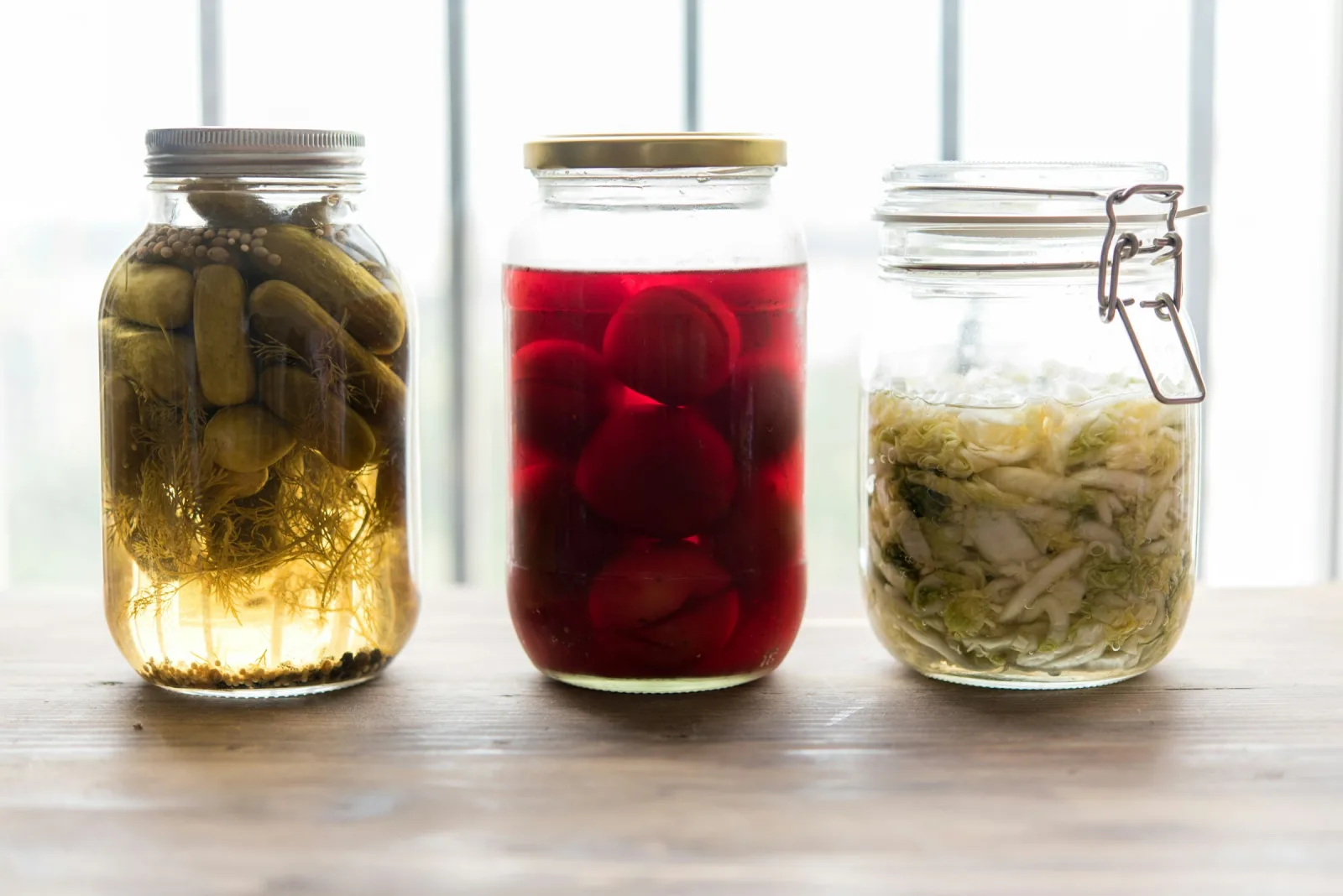
Fermented foods are a reasonable everyday choice, and the new guidelines name them. The Dietary Guidelines for Americans, 2025 to 2030 say that “vegetables, fruits, fermented foods (e.g., sauerkraut, kimchi, kefir, miso), and high-fiber foods support a diverse microbiome, which may be beneficial for health.”
The best-known trial is small. In a 2021 randomized study, healthy adults followed a high-fermented-food or a high-fiber diet for 17 weeks, with 18 people in each group. The fermented-food diet “steadily increased microbiota diversity and decreased inflammatory markers.” The high-fiber diet did not change diversity over that time.
A fermented food is not automatically a probiotic. An expert consensus from 2021 defines fermented foods as “foods made through desired microbial growth and enzymatic conversions of food components” and keeps the two categories separate.
Does gut health affect hormones?
There is a real link between gut bacteria and estrogen, but the human research is early. Nothing shows that a gut diet “balances hormones.” The term “estrobolome” was introduced in a 2011 review to describe gut bacteria that can process estrogen.
A 2017 review explains the idea: some gut bacteria make an enzyme called beta-glucuronidase, which can turn used estrogen back into its active form so it re-enters the blood.
The human evidence is thin. The most cited study, from 2012, looked at just 51 adults: 25 men, 7 postmenopausal women and 19 premenopausal women. In men and postmenopausal women, a more diverse gut was linked with higher estrogen levels in urine. In premenopausal women, estrogen levels were “completely unrelated” to the gut measures. This was one snapshot in time, so it cannot show cause. If you have hormone symptoms, talk to your doctor rather than relying on a gut test or supplement.
Which everyday foods are good for your gut?
The foods with the best support are plain ones: beans, lentils, fruits, vegetables, seeds and fermented foods. The fiber amounts below come from the USDA FoodData Central database.
| Food | Typical portion | What it gives your gut |
|---|---|---|
| Lentils, cooked | 1 cup | 15.6 g fiber |
| Chia seeds | 1 oz (about 2 tbsp) | 9.8 g fiber |
| Raspberries | 1 cup | 8.0 g fiber |
| Black beans, cooked | 1/2 cup | 7.5 g fiber |
| Broccoli, cooked | 1 cup | 5.1 g fiber |
| Kefir | A glass | Fermented milk drink, named in the 2025 to 2030 guidelines |
| Sauerkraut, kimchi or miso | A small side or spoonful | Fermented vegetables or soy, also named in the guidelines |
Variety is the point. Mixing several fiber sources with a fermented food most days fits the pattern the guidelines describe.
What daily habits support a healthy gut?
Simple, steady habits help digestion more than any single product. These come from NIDDK’s list of common causes of constipation and gas, and from national activity guidelines.
- Add fiber slowly over a few weeks. In the 2022 review, gas was more common with fiber than with a placebo, so a gradual start helps.
- Drink enough fluids. NIDDK lists not drinking enough liquids as a cause of constipation.
- Move most days. The Physical Activity Guidelines for Americans advise at least 150 minutes a week of moderate activity, and too little activity is another listed cause of constipation.
- Go when you feel the urge. Ignoring it can change your bowel habits.
- Eat and drink more slowly, and cut back on fizzy drinks and gum, which make you swallow more air.
Read more about how we check the research on our About page.
Frequently asked questions
How can a woman improve her gut health naturally?
Eat a variety of high-fiber foods such as beans, lentils, berries, vegetables and seeds, add fermented foods like yogurt, kefir or sauerkraut, drink enough fluids and stay active. Most women eat about 15 grams of fiber a day, so raising it slowly toward 25 grams is a useful first step.
What is the best probiotic for women’s gut health?
No single probiotic is proven best for women’s gut health. Benefits depend on the strain and the problem, and reviews show mixed results. Ask your doctor or pharmacist before starting one, especially if you have a health condition.
Can gut health affect hormones?
Some gut bacteria can process estrogen, a system called the estrobolome. Human studies are small and early, and none show that changing your diet or taking a supplement balances hormones.
How long does it take to improve gut health?
There is no fixed timeline. In one small trial, a diet high in fermented foods changed gut bacteria over 17 weeks. If you raise fiber, do it over a few weeks to limit gas and bloating.
These statements have not been evaluated by the Food and Drug Administration. This product is not intended to diagnose, treat, cure, or prevent any disease.
This article is for education and is not medical advice. Talk to your doctor before changing your diet, supplements, or medication.
Health Science Mag is an educational publication. Articles are for information only and are not medical advice. Talk to your clinician before changing your supplement routine.